
Excerpt from Women of Strength by Betty Jane Cooper Johnson as told to Suzan Huney
Suzan Huney used what she’d learned about taking and publishing oral history in her recent book, Women of Strength, by Betty Jane Cooper Johnson as told to Suzan Huney. The following excerpt from their work together illustrates the way oral histories evoke time and place as well as the personality of the interviewee, while informing and entertaining.
My husband’s name is Russell Roy Johnson. He was born on January 30, 1921, in Mercy Hospital in Williston, North Dakota, to Roy Sewell Johnson and Francis Ann Johnson. He had no siblings. He grew up in Ray, North Dakota. I met Russ in Ray in the fall of 1925, so he says. I was sitting on the lawn at Harry Irwin’s with my nephew Sonny and niece Marion. But, I was only two then, and I don’t remember meeting Russ.
Russ and I had our first date at Kota-Ray Lake on June 16, 1939. I was sixteen. The night before, my niece Marion and I had been to the Redlick’s barn to dance. Russ was there and we danced a tune or two. Afterward I spent the night at Marion’s house. The next afternoon we lounged in her yard, looking cool in case some boys might drive by; and then Russ cruised by in his 1928 Chevrolet Coupe. He was uptown all right. Not too many had their own cars then, I tell you. He stopped and asked if we’d like to drive out to Kota-Ray Lake just for something to do. From then on we were a couple. That was the beginning of sixty-seven years of romance.
On Saturday nights we went to barn dances or movies in Williston. We drove around a lot in Russ’s 1928 Chevrolet coupe, a cute car with a rumble seat. A couple of years before we married, in 1941, Russ bought a light green 1938 Chevrolet. We thought we were uptown riding in that Chevrolet.
On December 7, 1941, Russ was en route to a job in Denison, Texas, to work on a dam. He was in Kansas City when he heard that Pearl Harbor had been bombed. The next day he headed to Wichita, because he’d heard they were hiring at the Cessna Aircraft Company. He was hired immediately.
Pearl Harbor was bombed on a Sunday. Roosevelt declared war shortly thereafter. Mom, Dad and I were together in the living room of our home when we listened on the radio as Roosevelt told the nation we were going to war. We also listened to the Hans von Kaltenborn, an American radio commentator, one of the first to provide analysis and insight into news stories, announce the bombing of Pearl Harbor. He said, “Japan has made war upon the U.S. without declaring it. Pearl Harbor and Manila were attacked. Damage, fires on Hawaii. About 50 planes in the attack, many were shot down.”
That Christmas Russ received a Christmas turkey and four days off from work. Unbeknown to me, he put his turkey in the car and headed for North Dakota. On Christmas Eve Russ found me at Ruth’s in Williston. Mom and Dad and I were there for Christmas. There was a knock on the door and when I opened it, there stood Russ. I hadn’t seen him since the first of the month. It was a total surprise to me. Right off, while I stood in the doorway, he asked me to marry him. He said there was a waiting period in North Dakota, but he thought we could dash over to Montana and get married, and then immediately return to Wichita. I was blown away. Caught off guard. I didn’t know what to say. Then I said I couldn’t. Russ gave me the turkey and left for Ray to see his folks.
After I had time to think about it, I decided to marry Russ. I sent him a telegram to tell him I would arrive in Wichita on January 30, 1942, to get married. I asked him to meet me at the train station.
Mom and Dad liked Russ, and they knew we were serious. They had no objections. I had less than one month to get ready. I had to give notice at the Epping High School library that I was quitting my work-study job. I also had to get a few clothes together, including my wedding dress. Mom and Alice and I shopped at Hendricks Department Store in Williston. I bought my wedding dress for $6, if you can believe it, and a hat, purse, and a pair of pumps. My dress was beige wool, street length. The purse and pumps were brown.
I was lucky that Alice had come home for Christmas in 1941, because in 1938, after being jilted by her boyfriend, Judd Huney, she moved out West to Chehalis, Washington, where her good high school friend, Jo Schlickte, had moved. I was glad to have Alice’s help in picking out my wedding clothes. It was also on this trip home that Alice took the train to La Crosse, Wisconsin, where Judd was living, and spent a week with him. Not long after that, Judd moved out West, too, so he could be near Alice.
The Empire Builder train didn’t stop at the Epping Station. The station master had to make special arrangements to flag the train down. On January 29, 1942, the master stopped the Great Northern Empire Builder. I boarded it with my suitcase, a suitcase that I had borrowed from Russ’s mother. I had never been more than one hundred miles from my home. I felt scared to death. As the train tooted its departure, I looked out the window. I waved at Mom and Dad. Both were crying. So was I. I had to change trains in St. Paul, Minnesota. That was a nightmare. It was a huge station compared to our podunk Epping station; and trains were going every which way. I finally found a train heading to Wichita Falls. I had stowed my suitcase in the overhead rack and had just sat down when a conductor asked to see my ticket. He asked me where I was going. When I told him Wichita, he said, “Lady, you’re headed for Wichita Falls, Texas. Get off this train.” He hustled me off the train, and someone else helped me find the right one. Here I was, a country bumpkin, never further from home than Minot, on my way to Kansas to be married.
Early the next morning, the train pulled into Wichita. I can still hear the conductor call out Wichita, Wichita, as he walked through the car. The conductor yelled for people to hurry. Get off, the train. It wasn’t stopping long. But sometime during the night I had taken off my shoes. I had to get down on my hands and knees and search for my shoes. Finally, I spotted them several seats back, jiggled there during the night. I put my shoes on, grabbed my purse and suitcase. When I got to the doorway and looked out, Russ was right there at the train station to meet me. Total relief.
The first thing we had to do was find the courthouse so we could get a marriage license, which we did. Then we went to the Methodist Church and asked the minister if he would marry us. He said yes. I changed into my wedding attire in the church bathroom. We were married in the parsonage. Russ had arranged with a fellow he worked with and his wife to be our attendants. Cleo Gould, Russ’s cousin, who was working with Russ at the airplane factory, also attended and stood up with us. The other couple we never saw again after the wedding. This was wartime.
We were married on January 30, 1942, on Russ’s twenty-first birthday. It all happened so fast.
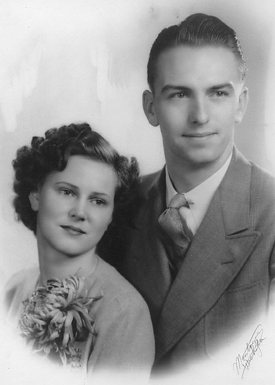
Betty & Russ on their wedding day
After the ceremony we went to a restaurant for lunch. Then Russ and I went back to the furnished cabin he had rented. The cabin had one room with a tiny kitchen and a bathroom. Russ’s mother had mailed him an angel food cake for his birthday so Russ made coffee and we drank coffee and ate cake. Then it was time for Russ to leave for his four o’clock to midnight shift at the factory. When he got home past midnight, I was in tears, lonesome, and wondering what I’d done. Alone without my family, afraid I would never see home again.
During the summer of 1942 Dad sent me a telegram asking me to come home, that Mom was sick. Russ drove non-stop from Wichita to Epping. We had our dog Penny with us. We had no one to leave Penny with back in Wichita. Russ dropped me off at Mom and Dad’s and then he made a quick run out to Ray to see his folks. Then he had to head back to Wichita for work. Mom was very depressed. She was seeing a chiropractor in Williston who was recommended to her by Aunt Maud. The chiropractor was giving Mom what they called high enemas with some kind of red liquid and a drug. Some people, like this quack chiropractor, thought sluggishness, the feeling of heaviness, or over-sleepiness, was caused by the absorption of poisons through the colon. Dad and I were disturbed by what he was doing. We talked Mom out of seeing the chiropractor, and into seeing a regular doctor, Dr. Jack Craven.
Dr. Craven was outraged by the enema treatments. He gave her a prescription of Laudanum (also known as Tincture of Opium). It was reddish-brown in color and extremely bitter. We didn’t know at the time that it was a potent narcotic. Mom took the Laudanum until she moved out West to Bainbridge Island. Dr. Wilt, her new doctor on Bainbridge Island, prescribed a medication for depression, probably Chlorpromazine (marketed as Thorazine), a pharmaceutical treatment available in the early 1950s. Mom took those pills, or one similar, until the day she died. I remember how after she moved to the nursing home, she’d be at the nurse’s station a half-hour ahead of the medication distribution. The nurses always made her wait.
I stayed with Mom and Dad for about a month. Mom seemed much better by the time Russ came to drive me back home to Wichita.
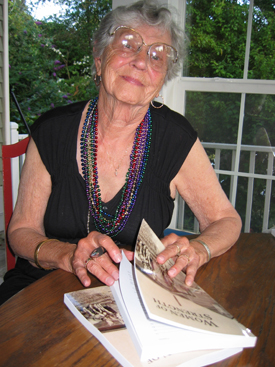 Betty signing her book